
Revision Hip Replacement Surgery
Revision Hip Replacement Surgery
Overview
During primary total hip replacement surgery, the hip joint is replaced with an implant or prosthesis made of metal, plastic, and/or ceramic components. Although most total hip replacements are very successful, problems can develop over time. These problems may require a revision procedure to replace the original components.
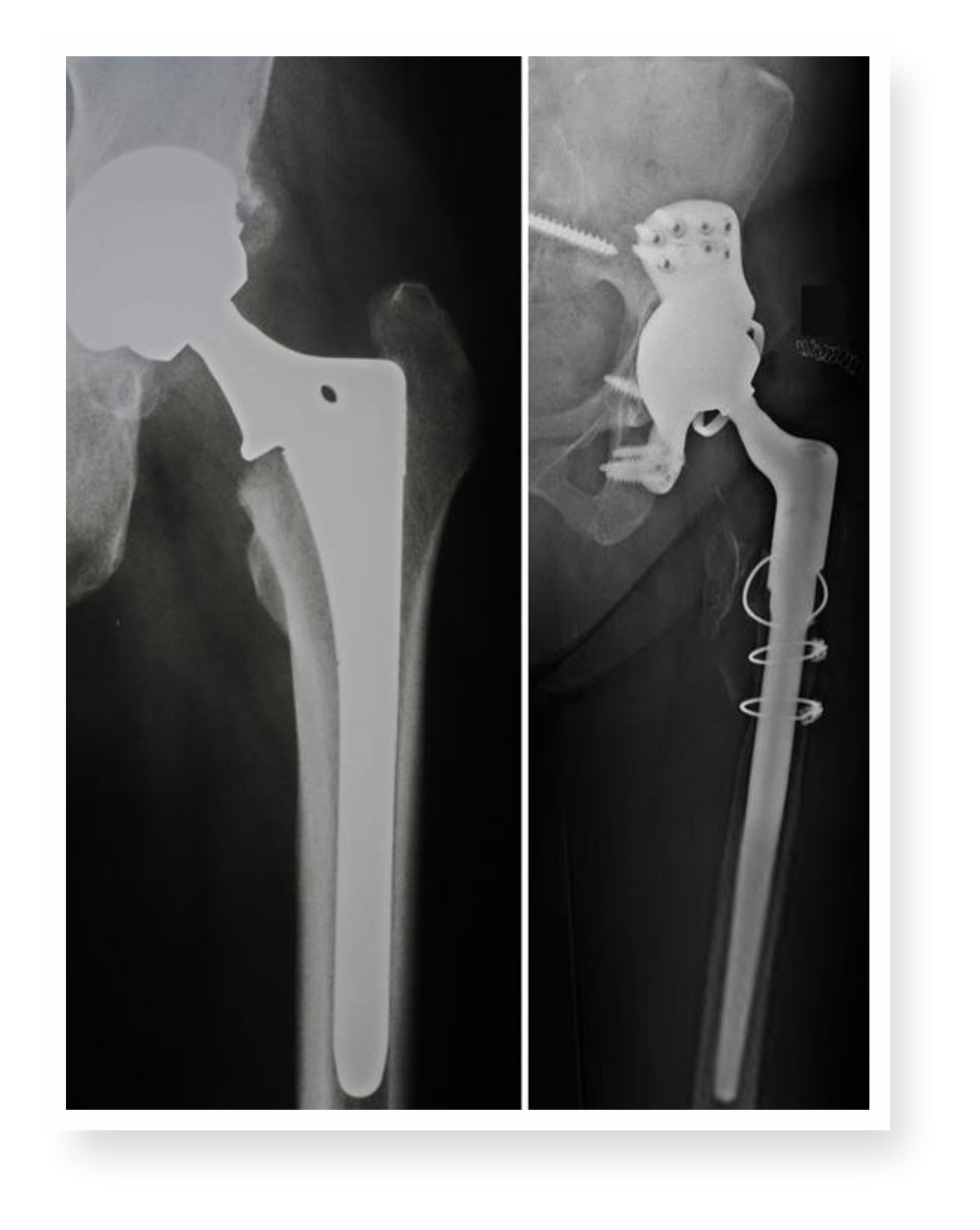
There are different types of revision surgery. In some cases, only some components of the prosthesis need to be revised. In other cases, the whole prosthesis needs to be removed or replaced and the bone around the hip needs to be rebuilt with augments (metal pieces that substitute for missing bone) or bone graft.
Damage to bone and soft tissue around the hip may make it difficult for the doctor to use standard primary hip implants for revision hip replacement. In most revisions, the doctor will use specialized implants that are designed to compensate for the damaged bone and soft tissue.
Preventing the need for revision hip surgery
It is vital for a hip replacement patient to be aware of the risks of infection and implant failure, and to monitor themselves postsurgery. Some of the above-mentioned forms of failure can be prevented.
Dislocations can be prevented by following the surgeon’s instructions. Some forms of hip infection can be prevented by prompt treatment of other bodily infections and by taking antibiotics before certain dental and other procedures.
The natural wear and tear of a prosthesis generally causes no pain or discomfort. Therefore, it is very important for the patient to have his or her hip replacement regularly checked. A simple physical examination and radiographs (X-rays) are necessary at intervals designated by the surgeon. If excessive wear and/or bone loss is detected at any time, close monitoring is necessary to determine the best possible time (if any) to have the hip replacement revised.
Things to keep in mind when considering revision hip surgery
During revision surgery, the surgeon may need to remove or exchange one or more parts of the hip replacement. The parts that are not attached to the bone can be safely exchanged with minimal to no removal of the patient’s bone. However, if the metallic parts in contact with the bone need to be changed, some bone loss generally occurs. In addition, some of the musculature around the hip will be lost, thus affecting the strength of the hip and the patient’s function after surgery. The results of revision surgery are not as predictable as those of the primary surgery. Complications are more frequent.
"My mother had visited the hospital and it was muscle tear issues. Consultation was fine by the doctor. We have plans to go again as we need to take injection. We are satisfied with the explanation and treatment given. I can surely recommend doctor to my family or friends circle. Doctor was very friendly."
"I have consulted Dr. Rahul Puri for my left hand wrist fracture. I underwent k wire close surgery. The doctor has explained me the whole treatment really well and was very friendly during the recovery."

"I had fracture and shoulder related issues so went to hospital. Consultation was very nice by the doctor. I can surely recommend doctor to my family or friends circle. I had fallen actually. There was no waiting time when we went. X-ray was suggested and physiotherapy was suggested. Medicines was prescribed by doctor during consultation."